
What is laparoscopy?
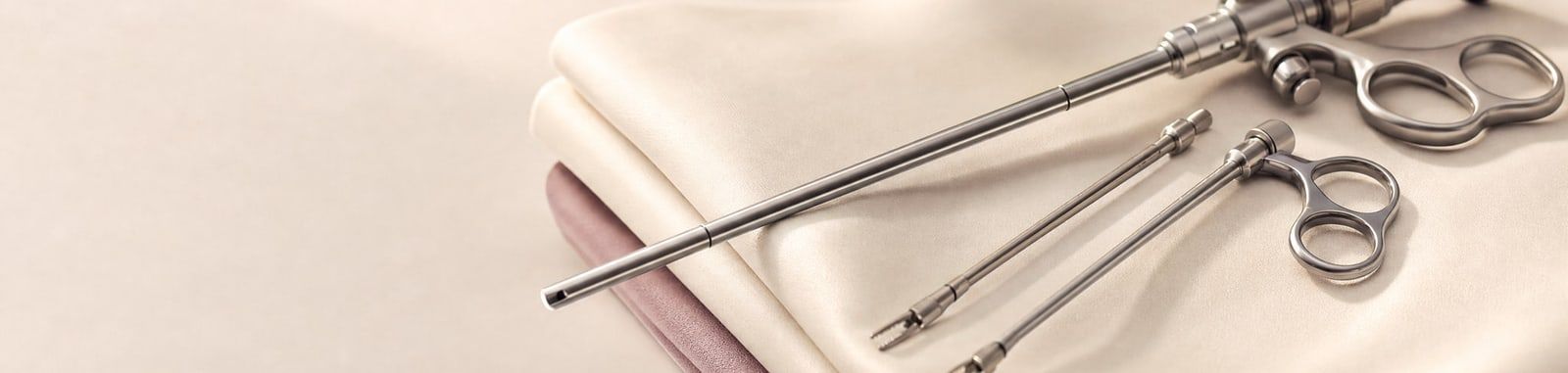
Surgery through small openings
Unlike so-called “open” surgery, where the diseased organ is made visible through an incision several centimetres long, with minimally invasive surgery we insert all the necessary precision surgical instruments, in miniaturised form, into the patient’s body through small openings. A small video camera transmits high-resolution images of the operating field, magnified up to 15 times, so that the affected organs can be assessed from different angles. In this way the internal organs can be seen precisely and in detail. The operation takes place inside the closed body cavity (the peritoneal cavity). Compared with conventional techniques, this approach to gynaecological conditions offers the patient a number of advantages:
- Minimally invasive surgery (laparoscopy) is a surgical treatment that causes the least possible trauma.
- With minimally invasive surgery (laparoscopy), the aim is to diagnose conditions more gently and to treat them more gently.
- Specialised minimally invasive surgical procedures are possible thanks to the latest technology, with endoscopes (laparoscopes) and very small instruments.
- The operation does not involve an abdominal incision, only small openings in the skin. The instruments are inserted into the patient’s body through these openings. This avoids opening up a large area of tissue, while the video camera gives an overview of the whole body cavity.
- Many gynaecological conditions can be treated with this technique without an abdominal incision.
- As a result, recovery time is shorter, almost minimal, and, most importantly, the woman goes home after 2–3 hours.
- Less bleeding
- Less pain
- Protection of the smaller nerves and blood vessels
- A more favourable, better cosmetic result (smaller, barely visible scars)
Medical content by the Fertility Clinic team